


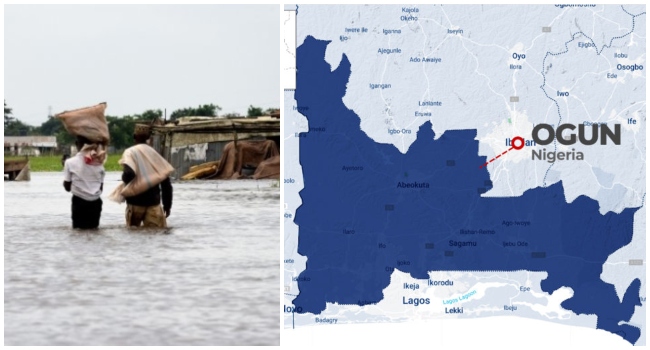
The Ogun State government has called for proper planning, early warning, public awareness, and effective emergency response in anticipation of the expected 72-hour rainfall and flooding expected to hit the state in the coming days.
The Ogun State Deputy Governor, Noimot Salako-Oyedele, made the call in Abeokuta, the state capital, during the full-scale flood disaster response simulation exercise organised by the National Emergency Management Agency (NEMA) for the South-West states of the country
While calling for sincerity of purpose, the deputy governor, however, enlists the understanding and cooperation of traditional rulers, community leaders, local governments, security agencies, health workers, volunteers and the media for adequate information
“The 2026 Seasonal Climate Prediction and Annual Flood Outlook have identified a number of high-risk flood-prone locations across the country, including areas within Ogun State. This reinforces the need for us to remain,” she said.
“This simulation exercise is therefore both timely and important. It gives us an opportunity to test, in practical terms, the preparedness of our institutions and the ability of all critical stakeholders to work together in the event of a flood emergency. Plans and protocols are important, but they must also be tested. We need to know how quickly we can mobilise, how effectively agencies can communicate and coordinate, and how efficiently we can reach and support affected communities.”
Salako-Oyedele commenced the synergy between the Ogun State Government and the National Emergency Management Agency, a development she said has given the state leverage in its disaster management.
“I commend NEMA for initiating this exercise and for its continued collaboration with the Ogun State Government through OGSEMA. Over the years, this partnership has strengthened our capacity to respond to floods, fires and other emergencies. It has facilitated better coordination, faster deployment of responders and improved humanitarian assistance to affected persons,” she said.
“The Ogun State Government recognises that effective emergency management requires adequate preparation and investment. We have therefore continued to support OGSEMA with the resources required to carry out its responsibilities, including training for its personnel, local emergency responders, Local Government officials, volunteers and community emergency teams.”
“We have also supported the provision and deployment of rescue equipment, ambulances and other emergency response resources, while ensuring that relief materials and financial assistance are made available, where necessary, to support people and communities affected by disasters.”
A call for all bands to be on deck
“However, disaster management cannot be the responsibility of government agencies alone. Communities themselves have an important role to play. Our people must take early warning information seriously, avoid building on waterways and drainage channels, desist from indiscriminate dumping of refuse, and cooperate with relevant authorities when evacuation or other preventive measures become necessary,” she said.
“Our traditional and community leaders, Local Governments, security agencies, health workers, volunteers and the media are equally important partners in ensuring that information reaches our people quickly and that communities know what to do before, during and after an emergency.”
“I therefore encourage everyone participating in this exercise to treat it as a genuine learning opportunity. Let us identify any gaps in our systems, communication and coordination and use the lessons from this exercise to improve our preparedness. The true value of today’s simulation will be measured by how well the lessons learnt translate into faster, safer and more coordinated responses when an actual emergency occurs.”
“On behalf of the Government and good people of Ogun State, I appreciate the Director-General and management of NEMA, the leadership and personnel of OGSEMA, our emergency responders, security agencies, health personnel, Local Government authorities, volunteers and all other stakeholders participating in this exercise. Our administration will continue to work closely with NEMA and all relevant partners to strengthen disaster preparedness, protect vulnerable communities and safeguard the lives and property of our people.”
Representing the Director General of NEMA at the occasion, the Director of Search and Rescue, Commodore Nature Usman, called for proper strengthening of coordination, communication and response.
“We must be proactive and coordinated in our resolve to mitigate the potential impacts on lives and means of livelihood. As we all know, flooding remains one of the most recurrent and devastating natural hazards in Nigeria, with far-reaching consequences for lives, livelihoods, infrastructure, the environment and communities. The increasing frequency and severity of flood events underscore the need for strengthened preparedness, early warning, anticipatory action and effective response mechanisms,” he said.
“The devastating flood disaster recently witnessed in Nepal on 26 August 2026 provides another sobering reminder of the destructive potential of flood events. The flash floods along the Bhote Koshi and Trishuli River corridors caused extensive loss of life and damage to homes, roads, bridges and critical infrastructure, while search and rescue operations continue.”
He also called for heeding the early warning and vigilance by communities and first responders.
“This tragedy demonstrates the importance of early warning systems, risk communication, preparedness and the capacity
to mount rapid, coordinated search and rescue operations,” he said.
“These incidents reinforce the importance of exercises such as this one, which enable responders to test plans, identify gaps and strengthen coordination before lives and property are placed at risk. Therefore, the essence of this simulation exercise is not only to test our existing plans, procedures and response protocols, but to also identify gaps, generate lessons and strengthen inter-agency collaboration and interoperability in disaster response.”
“Today, we are simulating a crisis so that we can be better prepared to save lives when a real disaster occurs. Let me reiterate that preparedness is key to saving lives. Our ability to anticipate, respond to, and recover quickly from disasters depends largely on how well we plan, train, coordinate, and work together before disaster strikes.”