


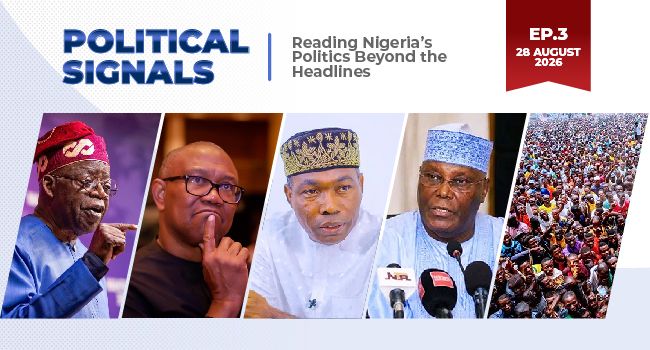
THE APC IS CONSOLIDATING. THE OPPOSITION IS STILL NEGOTIATING.
One week into Nigeria’s formal 2027 campaign season, the clearest emerging difference is organisational.
APC governors have publicly reaffirmed their support for President Bola Tinubu’s re-election and pledged to mobilise for him across their states.
Meanwhile, reports indicate that the camps of Atiku Abubakar and Peter Obi have not accepted the idea of a single opposition presidential candidate.
These developments suggest a contrast in political activity: the APC is publicly demonstrating cohesion around its incumbent candidate, while opposition actors are still negotiating leadership and structure.
The central question is no longer only whether the opposition should unite. It is whether it can agree on who leads, what the coalition stands for and how it would build an effective national organisation.
THE POLITICAL SIGNAL
THE OPPOSITION FACES BOTH A UNITY QUESTION AND A LEADERSHIP QUESTION
A coalition could combine political networks, regional strengths and voter constituencies. However, it would eventually need to resolve the question of the presidential ticket.
It may be easier for opposition actors to agree on the need to challenge the incumbent than to agree on who should lead that challenge.
The reports concerning Atiku and Obi illustrate this difficulty.
The opposition therefore faces two related questions:
Can it unite?
Can it unite around a governing proposition rather than only opposition to President Tinubu?
WINNER OF THE WEEK ↑
THE APC’S EXISTING ORGANISATIONAL ADVANTAGE
The APC’s current advantage includes an incumbent president, a substantial number of state governments, established local networks and governors publicly committing to the campaign.
Presidential elections require more than national visibility. They also require funding, voter mobilisation, messaging, election-day coordination and the ability to translate political support into votes.
The APC appears to have more of that structure in place at this stage.
Organisational position: ↑
LOSER OF THE WEEK ↓
THE ASSUMPTION THAT OPPOSITION VOTES CAN SIMPLY BE ADDED TOGETHER
Past performance does not automatically transfer from one candidate to another.
Some voters may follow their preferred candidate into an alliance. Others may reject the arrangement, abstain or support another candidate. Regional, religious, ethnic, economic and personal considerations may also influence voter behaviour.
The opposition therefore has to do more than combine politicians.
It must persuade different electorates to accept a common candidate and a common national message.
THE ATIKU QUESTION
AGE, EXPERIENCE AND SUCCESSION
Atiku Abubakar has responded to concerns about his age by asking whether he looks 80.
The comment reflects a broader issue that every presidential contender may face: questions about fitness, capacity, experience and succession.
Atiku’s experience may be presented by supporters as an asset. Opponents may present his age as a reason to seek generational change. Whether the issue affects voter behaviour cannot yet be established, but it is likely to remain part of the political debate if he remains a leading opposition figure.
THE TINUBU ADVANTAGE
STRUCTURE BEFORE SENTIMENT
President Tinubu’s current position includes the advantages of incumbency, party organisation, support from governors and an emerging campaign structure. Opposition fragmentation may also affect the competitive environment.
These factors do not guarantee re-election, but they provide a strong organisational starting point. A recent assessment identified Tinubu as having the strongest pathway to re-election among the major contenders, although that remains an assessment rather than a forecast of the result.
On the evidence currently available, the structural case for Tinubu appears stronger than the opposition’s organisational case against him.
That does not establish voter preference. Organisation is not the same as public confidence. If voters conclude that government has not improved their circumstances, the APC’s organisational advantage may not be sufficient.
The issues likely to shape that judgement include:
- cost of living;
- jobs;
- security;
- infrastructure;
- public services;
- and confidence in the country’s direction.
The opposition’s task is to turn dissatisfaction into a coherent alternative. The APC’s task is to persuade voters that its record merits another term.
THE VOTER
Candidates are increasingly being asked to defend their records and explain what they would do differently.
That is where the 2027 conversation should move—not only to defections, personal exchanges or alliance announcements, but also to:
Which candidate has the most credible plan for governing Nigeria?
THE ELECTORAL CHESSBOARD
NORTH
Kaduna Governor Uba Sani has predicted strong support for Tinubu in Kaduna and rejected suggestions that Northern voters are turning against the President.
That is a political claim by a supporter of the President, not independent evidence of voter intention. The opposition cannot assume that dissatisfaction will automatically translate into votes for its coalition. The North remains electorally significant and will require active competition from all major campaigns.
SOUTH-WEST
Osun remains evidence that APC dominance is not uniform across the South-West. Adeleke’s victory showed that opposition candidates can win a competitive contest in the region.
Whether that result reflects a local political dynamic or a broader shift cannot yet be determined.
SOUTH-EAST
Peter Obi remains a significant political figure, particularly because of the support he demonstrated in the 2023 presidential election. The unresolved question is whether that support can be converted into a broader coalition capable of competing across Nigeria.
That is a question of organisation and voter alignment, not simply personal popularity.
SOUTH-SOUTH
Wike has said that a broader coalition supporting Tinubu is emerging.
At present, the scale and electoral significance of that proposed coalition require further evidence. Relevant indicators will include who joins, what political structures they control and which constituencies they can credibly mobilise.
“Do I look 80?” ⁃ Atiku Abubakar
The comment responds directly to an age-related political criticism. Its electoral significance is not yet measurable.
Voters will ultimately assess every candidate on practical questions:
Can you lead?
Can you deliver?
Can you address the problems that matter to me?
WHO BLINKS FIRST?
If Atiku and Obi both seek to lead, can a coalition accommodate both ambitions?
If neither gives way, can the coalition remain electorally effective?
One possible consequence is that continued competition among opposition leaders could preserve the APC’s organisational advantage. That is an analysis of the current situation, not a prediction of the election result.
The longer the leadership question remains unresolved, the more time the APC has to consolidate its existing structure.
01 – THE OPPOSITION’S NEXT MEETING
Will the talks produce a formal political framework, or another statement of intent?
02 – ATIKU AND OBI
Watch their decisions, public commitments and organisational actions rather than relying on supporters’ arguments or speculation.
03 – THE RAINBOW COALITION
Who joins the proposed coalition supporting Tinubu, and what political structures or constituencies do those participants represent?
04 – THE ECONOMY AND SECURITY
POLITICAL SIGNAL
THE APC CURRENTLY HAS THE STRONGER STRUCTURE. THE OPPOSITION HAS THE STRONGER INCENTIVE TO SEEK A COALITION.
The APC is consolidating support from governors and building campaign structures around an incumbent president.
The opposition has prominent political figures and a potential anti-incumbency argument, but it has not yet resolved who leads or what a coalition would represent.
On the evidence currently available, its political potential appears greater than its organisational cohesion.
It is too early to forecast the outcome of the 2027 election. It is not too early to identify the current organisational balance.
The APC currently has the stronger structure.
The opposition has the stronger incentive to build a coalition.
The opposition must turn individual political ambitions into a coalition, the coalition into an organisation and the organisation into a credible national proposition.
The APC must convert its political structure into public confidence and demonstrate that its record merits another term.
When the campaign develops further, voters are likely to focus on a practical question:
> Which candidate do we believe can govern effectively?
The answer will depend on campaign performance, voter assessments, economic and security conditions, candidate selection, turnout and the effectiveness of each party’s organisation.