


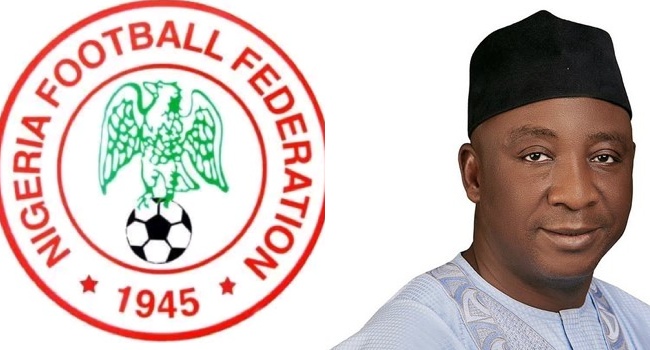
Former Nigeria international and football administrator Segun Odegbami has warned that changing the leadership of the Nigeria Football Federation (NFF) will not resolve the deep-rooted problems confronting Nigerian football.
Odegbami said this of the resignation of NFF President Ibrahim Gusau and the federation’s General Secretary, describing the development as only a “small issue” in a much bigger crisis that has engulfed Nigerian football for nearly three decades.
According to the former Green Eagles captain, Nigerian football has become entangled in a complex web of administrative, legal and structural problems that few people fully understand.
“In the past almost 30 years or so, we have tied ourselves into a knot,” Odegbami said during an interview on Channels Television’s breakfast show on Friday.
He argued that the recurring crises in Nigerian football cannot be solved simply by removing officials and replacing them with a new set of administrators.
“We have removed, one way or the other, the people on the board and we might as well just say, ‘Look, let’s get a new set to go on,’ but we’ll get the same results,” he said.
Odegbami noted that the situation is further complicated by the fact that football attracts opinions from virtually everyone, with stakeholders often convinced that they have the right solution.
“Football is a sport that everybody is an expert. Everybody has an answer, and everybody is right,” he said.
“The answer lies in unknotting this complicated situation that we have, that is not making things clear, so that everybody can have a clear idea of what we need to do to move forward,” he said.
Reacting to claims by the outgoing NFF president that he was leaving Nigerian football better than he found it, Odegbami acknowledged that the administration may have recorded some achievements.
However, he argued that such accomplishments ultimately mean little to ordinary Nigerians if they do not translate into success on the pitch.
“I’m sure he believes what he says and if you look at the issues that he’s talking about, yes, he has achieved some level of success,” Odegbami said.
“But as far as the man on the street is concerned, if your team does not win on the field of football, you have lost. That is the only measure for success or failure of a sport like football.”
For Odegbami, the bigger objective should be to create a sustainable football system capable of producing success consistently rather than relying on periodic changes in leadership.
He pointed to countries such as Brazil and England as examples of football systems built around continuity.
“You have to have a production line, a seamless production line, so that every year, as Brazil has done, they have always gone to the World Cup,” he said.
NFF Not Recognised Legal Entity
Odegbami also raised what he described as a fundamental legal issue surrounding the identity and status of the country’s football governing body.
According to him, the NFF is not recognised in Nigerian law, and there is a subsisting court judgment, which he said has not been vacated, concerning the legality of the federation.
“There’s a subsisting court judgment that has not been vacated up till now,” he said, adding that the judgment had been in place for almost a decade.
Therefore, the resignation of the NFF leadership should not be treated as the end of Nigeria’s football crisis, but rather as an opportunity to confront the deeper problems that have persisted for decades.
The priority, he argued, should not simply be finding new individuals to occupy the vacant positions but rebuilding a system that can deliver stability, accountability and sustained sporting success.
And while the outgoing administration may point to its achievements, Odegbami believes the ultimate verdict will continue to come from the football pitch.
“He succeeded,” he said. “But in the eyes of Nigerians, he is a failure.”